

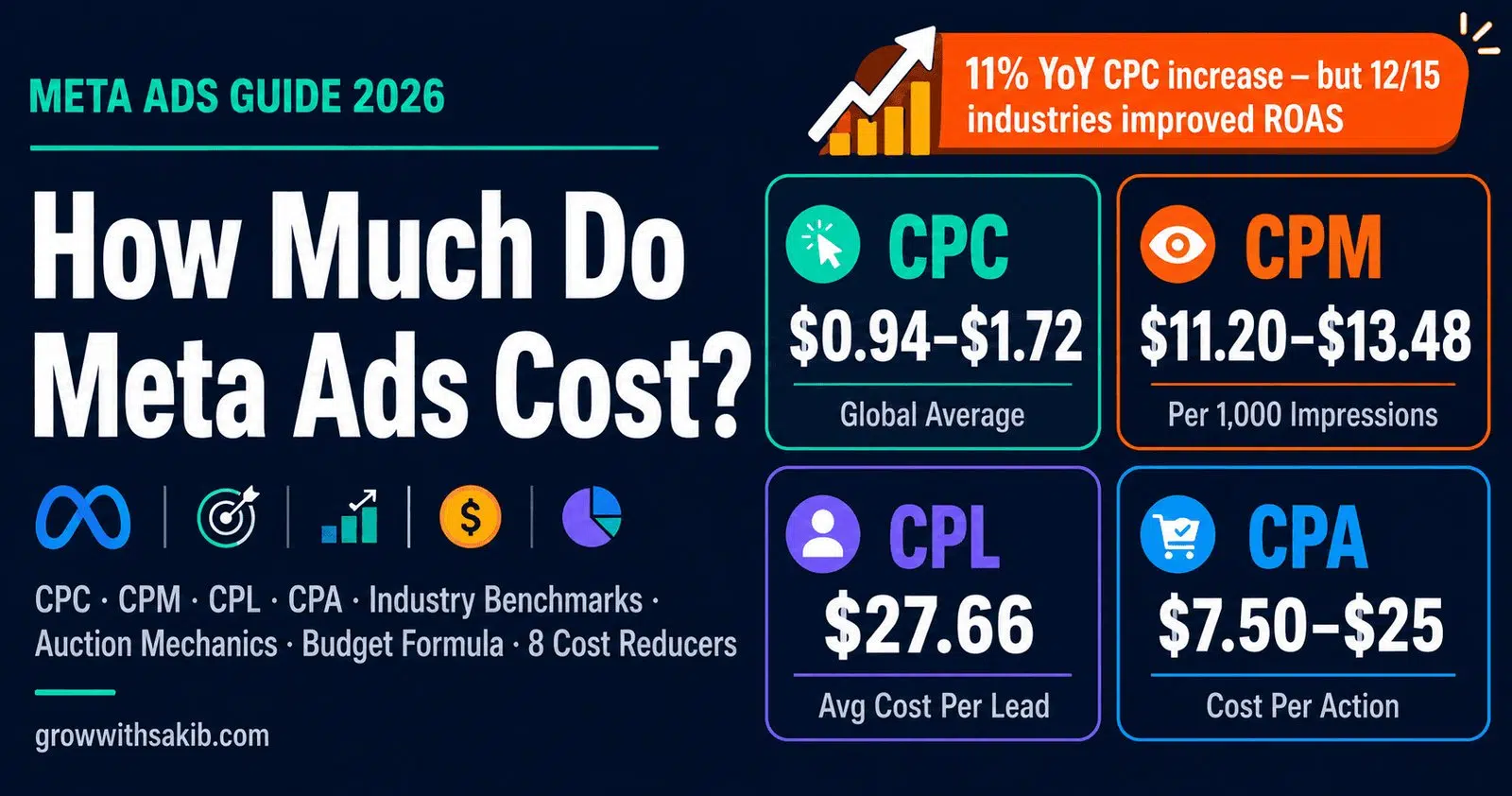
Meta ads cost as much as you choose to spend, starting at a minimum daily budget of $1 per ad set for impressions. Most businesses pay between $0.50 and $2.00 per link click, and finding out how much are meta ads depends entirely on your industry competition, your target audience, and your bidding strategy.
The short version
- Set a daily budget of at least $5.00 per ad set when optimizing for traffic or page engagement.
- Allocate a minimum of $20.00 to $50.00 daily per ad set if your campaign goal is online sales conversions.
- Expect click costs to range between $0.50 and $2.00 for standard retail, while professional services often exceed $3.50.
- Check your cost-per-result daily inside Meta Ads Manager to track your exact cost per thousand impressions (CPM).
- Stop any creative asset that fails to produce a profitable conversion after spending twice your target acquisition cost.
- Adjust bids manually only when you want to cap spend per result, otherwise leave bidding on lowest cost.
Why auction competition drives ad pricing
Meta calculates advertising prices through an automated auction system that scores your bid, your estimated action rates, and overall ad quality. Advertisers don’t buy ad space for a fixed price; instead, your ad competes against other businesses targeting the exact same demographic profile. During high-volume shopping periods like the fourth quarter, more brands bid for the same feed placements, which drives the baseline auction cost up across the board.
The system rewards ads that users interact with positively. When your creative earns high click-through rates, Meta lowers your effective cost per thousand impressions (CPM) because your content keeps users engaged on Facebook and Instagram. Conversely, if viewers hide your ad or scroll past quickly, Meta assesses a quality penalty, charging you significantly more money to show that ad to a thousand people. You can review standard billing thresholds directly in the Meta Business Help Center to see how billing limits apply to your account. This setup presents a clear trade-off: broad audience targeting gives you cheaper initial impressions, but hyper-specific niche targeting delivers higher intent at a substantially higher cost per click.
When the answer is different

These standard pricing estimates change dramatically depending on your objective, location, and industry vertical.
| Situation | What changes | What to do instead |
|---|---|---|
| Fourth quarter retail | Ad impressions cost twice as much | Shift spend to warm retargeting audiences |
| Highly regulated finance | Clicks often exceed five dollars each | Focus on high-intent lead generation forms |
| Local service radius under 10 miles | Audience pool exhausts within two weeks | Broaden your targeting radius or swap creative |
| Brand awareness objective | Clicks deliver almost zero sales | Switch your campaign objective to conversions |
| High-ticket B2B software | Lead forms cost over fifty dollars | Use qualification questions to filter bad leads |
| Account has no conversion history | The pixel lacks optimization data | Start with link clicks before targeting purchases |
How to do it properly
- Open Meta Ads Manager and select the campaign objective that directly matches your business goal, such as Sales or Leads.
- Enter a starting daily budget of $20.00 per ad set to give the delivery algorithm enough room to find conversions.
- Define your target audience by selecting your target geographic location, age range, and one or two broad interest categories.
- Upload at least three distinct creative variations, including one vertical video and two static images with clear headline text.
- Set your attribution setting to 7-day click and 1-day view so the platform can accurately credit delayed customer purchases.
- Publish the campaign and leave it completely untouched for at least 72 hours while the algorithm completes initial audience calibration.
- Review your Cost Per Result column inside the dashboard to verify your acquisition cost stays below your target profit margin.
The mistakes that ruin it
- Setting a daily budget below $5.00 for conversion campaigns, which leaves the algorithm without enough data to exit the learning phase.
- Editing your ad targeting, creative, or bid amount every 24 hours, which resets the delivery algorithm and drives up costs.
- Targeting tiny audiences under 50,000 people for cold campaigns, which causes ad fatigue and spikes your frequency rate quickly.
- Ignoring creative refresh cycles, which leads to rising CPMs as your target audience sees the identical image multiple times.
Frequently asked questions

Can I run Meta ads for only one dollar a day?
Yes, you can run an ad for $1.00 per day if your campaign objective is reach or brand impressions. However, this tiny budget isn’t enough to drive reliable product sales or qualified phone leads, because modern conversion algorithms require more daily spending to find users ready to buy.
Why do my ad costs change every day?
Your costs fluctuate daily because Meta uses a live bidding auction that shifts based on competitor activity and user availability. If many competing advertisers target your demographic on the same afternoon, your impression costs rise. Costs also jump when your audience sees the same creative too many times.
How long does it take for Meta ad costs to stabilize?
Ad costs typically take about 50 conversions per ad set within a seven-day window to stabilize. During this initial learning phase, your cost per result can jump up and down unpredictably. Once the system collects enough conversion signals, delivery evens out and costs become much more consistent.
What happens if I set my daily budget too low?
Your ad will stay stuck in the learning phase permanently if your budget can’t generate enough optimization events. When this happens, the algorithm never figures out which users are most likely to buy, causing your cost per acquisition to stay high while your ad reaches random users.
Does ad placement affect the total price?
Yes, placement choice directly changes your ad costs. Feed placements on Instagram and Facebook usually cost more per impression than placements in audience networks or right-column desktop ads. However, feed placements tend to generate higher conversion rates, making them more cost-effective overall despite higher initial CPM rates.
Is it cheaper to target broad audiences on Meta?
Yes, broad audience targeting generally produces lower costs per thousand impressions than narrow, interest-layered targeting. When you don’t restrict the platform with tight demographic rules, Meta finds the cheapest available ad inventory that still matches your selected conversion goal, keeping your overall campaign costs down.
Final Thoughts
Start by setting a small daily limit that fits your comfort level. It’s best to test different images and headlines to see what connects with your audience. Don’t worry if you don’t get it perfect right away; you’ll learn how to refine your approach as you gain more experience.